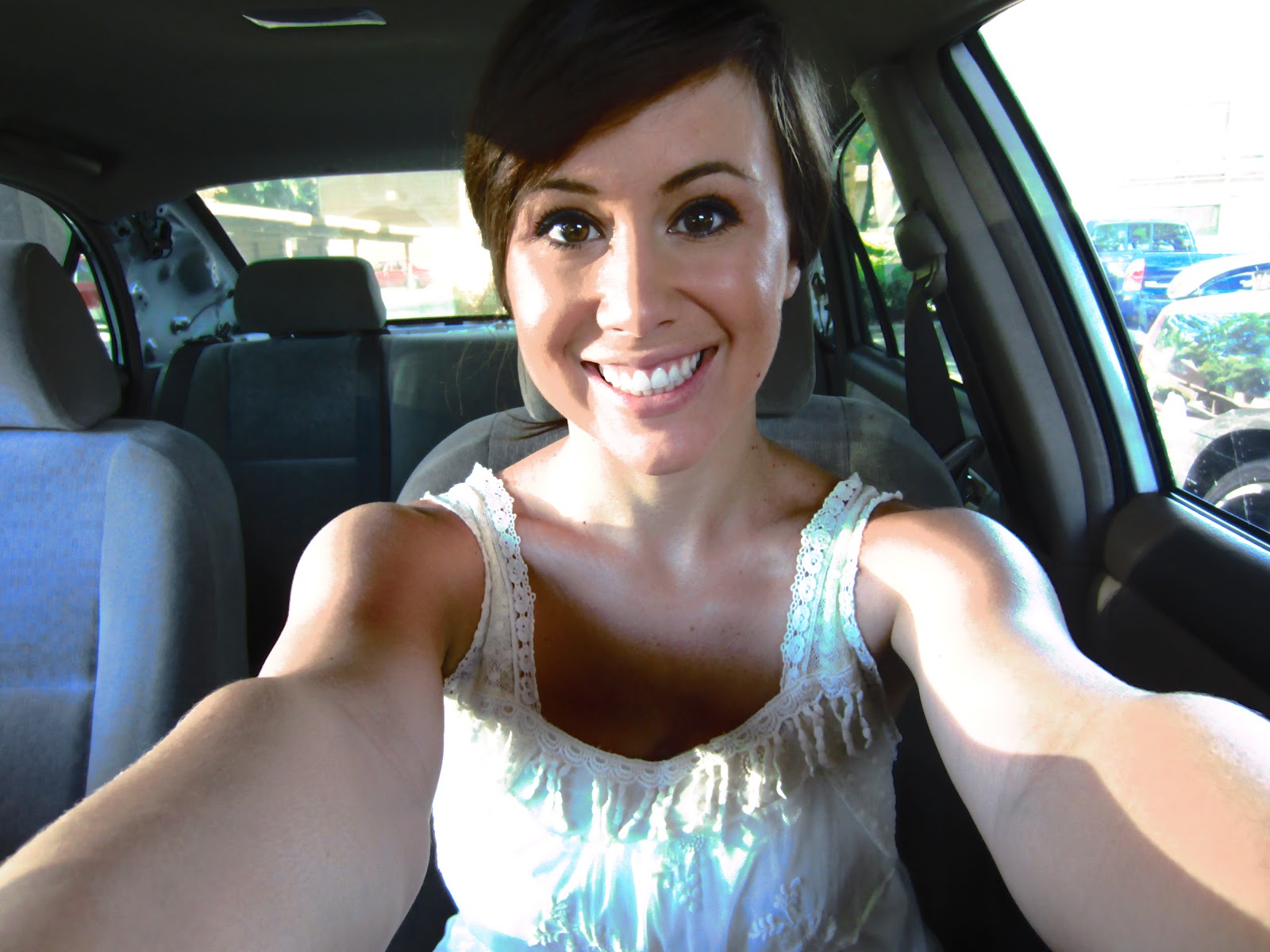
As last week was the National Eating Disorder Awareness week, I thought it appropriate to re-blog this article to promote awareness. Katie Levans is a blogger (you might have also seen her on the latest season of The Bachelor) I follow on the reg, and I love her approach to health, fitness, and body-image. The following article was originally found on Elephant Journal's website.
February 24 – March 2 is National Eating Disorder Awareness week.
I remember when I stopped eating. It was Christmas break of my junior
year of high school. The holiday was over and we had a little over a
week before returning to classes. I don’t know why or how but I made a
very clear, very conscious decision not to eat until New Year’s Eve.
I’d always had a preoccupation with weight and appearance. I wasn’t
obese by any stretch of the imagination (or medical definition), but I
certainly held on to my “baby fat” well into adolescence and therefore,
never got behind that ’90s girl trick of tying one’s shirt into a crop
top with a knot on one side. (In the end, I suppose that’s a fashion
bullet I artfully—albeit accidentally—dodged.)
I preferred baggy sweatsuits and leggings and wouldn’t wear a pair of
jeans until middle school. Swimsuits were absolutely out of the
question unless paired with an oversized t-shirt, an accessory
that—let’s be honest—only drew more attention to my feeble attempt to
disappear.
Today I’m a full-time yoga teacher and I live and breathe in
nothing-left-to-the-imagination
spandex, grateful every single day for a strong, healthy body that
carries me through life and for the practice that taught me to finally
love and appreciate that body.
But growing up my body was at no point something to celebrate. I
never saw it as a living, breathing miracle of science rapidly
replicating cell upon cell, building a framework of flesh and bone and
blood that would house my soul for the rest of my adult life. Instead I
always saw it as something shameful, something imperfect, something to
change.
Where did I learn this? Certainly not from my mom who didn’t allow
scales in the house and always disapproved of plastic surgery horror
stories on the news, shaking her head and reminding us we were perfect
the way we were. In fact, I can’t recollect a time I have ever heard her
speak negatively of her own appearance let alone mine.
I guess I could blame TV and movies,
airbrushed magazines that misrepresent what the human form is, and the resulting “beauty ideal” that is neither attainable nor existent.
And, really, it’s a combination of all of the above. The fact is
we’re born into an image-obsessed world that is constantly telling us to
be something and someone else: thinner, taller, tanner, sexier.
Skinny jeans not working with your actual genes? We can lipo
that! Pale? Spray on a tan! Pudgy? Pop a diet pill! Perfect? Impossible!
It’s sick, really.
My decision to stop eating in high school didn’t seem so abnormal to me at the time.
Everyone was dieting. Lots of girls wanted to lose weight. What
started as a week of seemingly innocent weight control quickly spiraled
into a lifetime of disordered eating behaviors, including extreme
calorie restriction, crash dieting, binging and exercise-induced
anorexia, all habits that people around me seem to consider “normal”
girl behavior.
I always choose my words carefully here: “disordered eating” instead
of “eating disorder.” Part of it’s because it sounds, ironically enough,
a little prettier. A little less crazy, if you will. And part of it’s
that I’ve never had an actual diagnosis and I feel that claiming an
eating disorder without really having one trivialize the estimated eight
million, sometimes fatal clinical cases in the US.
What I’ve experienced is what’s called an
Eating Disorder Not Otherwise Specified
(EDNOS), a catchall classification in the Diagnostic and Statistical
Manual of Mental Disorders (DSM-V) that covers any pattern of disordered
eating behavior that doesn’t fit the definition of Anorexia Nervosa or
bulimia.
Unfortunately, the sad reality is that
70 percent of all eating disorders fall under this category and,
therefore, are largely undiagnosed and untreated. In fact, our view is
so warped on the subject that clearly disordered behaviors have somehow
become the norm: skipping a meal to save calories, over-exercising to
compensate for an indulgence, eliminating entire food groups, bingeing
(even without purging) and an unrelenting preoccupation with food are
all disordered eating behaviors.
I’m not saying that healthy eating and weight loss are to be
abandoned, but an unhealthy preoccupation with either can be more
damaging—mentally and physically—than most people realize.
Recovery from eating disorders is rare,
and while treatment programs can help to normalize and stabilize, most
associated behaviors will last a lifetime.
Personally, I’ve never sought professional help, but I have
found—quite by accident—some semblance of normalcy only through an
unexpected practice of yoga.
When I first started practicing yoga six years ago, I did so (not
surprisingly) to lose weight (and ideally look like Jennifer Anniston,
who I heard through the tabloid grapevine was on her mat on the
regular). But what started as an exercise rooted in a preoccupation with
my appearance quickly taught me to transcend beyond my physical body to
something bigger.
I don’t recall one specific moment of clarity or the ever-elusive
sense of enlightenment yogis chase, but I do know that over time I
slowly stopped viewing my body as something to torture and starve and
punish with exercise and instead looked at it as an incredible machine
capable of carrying me through seemingly impossible poses and into a
life of unlimited possibility. For the first time ever my body became
something to celebrate.
While my experience is anecdotal, I know my story is not the only one
of its kind. In fact, there is even some emerging research that
supports yoga as a successful adjunctive therapy to standard eating
disorder treatments.
One study in the Journal of Adolescent Health found a decrease in eating disorder symptoms and decreased food preoccupation in a group of boys and girls ages 11-21. And
another in the Psychology of Women Quarterly
found that women who practice yoga report lower self-objectification,
greater body satisfaction and fewer disordered eating attitudes.
What’s so beautiful about yoga, I think, is that the practice uses the body to ultimately disconnect us from the body.
It seems counterintuitive at first, but dedication to a physical yoga
practice is what led me to the realization that I am not my body, that I
am not limited by its physical limitations nor defined by its
dimensions. And for that, I am forever grateful.
 Katie Levans
 is a full-time
yoga teacher,
writer,
fighter of hunger and dietetics school dropout with a Master of Science in Nutrition. She lives, works and plays in Charlotte, North Carolina.
www.katielevans.com | twitter: @sweettaterblog |
katierlevans@gmail.com